
RTCS OT Secure Guard
Protect Industrial Operations Before Cyber Threats Disrupt Production
OT Secure Guard is a defensive OT/ICS cybersecurity service for factories, utilities, industrial facilities, and critical infrastructure. We help secure PLCs, SCADA, HMIs, engineering workstations, industrial networks, and remote access paths without disrupting operations.
OT Reality
Industrial Cybersecurity Is Different from Traditional IT Security
Industrial environments have different constraints: uptime, safety, legacy equipment, specialized protocols, and operational continuity all matter. OT Secure Guard is designed around those realities.

Downtime Is Not Acceptable
Production availability is critical. Even short outages can cause safety, financial, and operational impact.

Legacy Systems Cannot Always Be Patched
Many OT systems run for decades. Patching or upgrades can introduce operational risk and require strict change control.

Flat Networks Increase Blast Radius
Unsegmented networks allow threats to move across critical systems faster than teams can contain them.
Visibility Is Often Limited
Limited telemetry and asset awareness can create dangerous blind spots across industrial environments.
Coverage
What OT Secure Guard Covers
Our defensive model combines asset visibility, segmentation review, secure access, detection engineering, risk prioritization, and incident readiness into one practical OT security engagement.
OT Asset Visibility
Discover and inventory OT assets, communications, vendors, firmware, and industrial protocols across your environment.
OT Network Segmentation Review
Evaluate and strengthen network boundaries, zones, conduits, firewall rules, and IT/OT trust relationships.
Secure Remote Access Review
Assess and harden vendor access, VPN exposure, MFA coverage, privileged accounts, and jump-host workflows.
OT Threat Detection Engineering
Build monitoring logic for abnormal OT behavior, suspicious remote access, new device events, and high-risk changes.
Vulnerability and Risk Prioritization
Prioritize risk using asset criticality, exploitability, exposure, operational impact, and patch feasibility.
OT Incident Readiness
Prepare playbooks, escalation workflows, backup validation, containment options, and recovery coordination.
 OT Secure Guard Platform
Preview the Defensive OT Visibility Layer Built for Industrial Cyber Resilience
OT Secure Guard Platform gives executives, plant teams, and security analysts a unified preview of how RTCS structures industrial cybersecurity visibility across assets, risk, governance, and operational resilience. The dashboard suite below is a client-facing preview model designed to communicate what your organization can monitor, prioritize, and improve.
Risk Trend Over 30 Days
Top OT Risk Categories
Incident Status
Critical Assets at Risk
| Asset Name | Site / Zone | Primary Risk | Score | Criticality |
|---|---|---|---|---|
| PLC-PAK-01 | Plant A / Process Line 1 | Unpatched System | 92 | Critical |
| HMI-WTR-02 | Plant B / Water Treatment | Remote Access Exposure | 87 | Critical |
| ENG-WS-01 | Plant C / Engineering | Weak Segmentation | 78 | High |
| SCADA-SRV-01 | Utilities / Control Room | Legacy System | 71 | High |
Site Risk Overview
| Asset | Threat | Impact | Overall | |
|---|---|---|---|---|
| Plant A | 80 | 75 | 85 | 80 |
| Plant B | 70 | 65 | 70 | 68 |
| Plant C | 60 | 55 | 65 | 60 |
| Utilities | 55 | 60 | 60 | 58 |
| Warehouse | 30 | 25 | 35 | 30 |
Priority Actions
Asset Distribution by Type
Asset Inventory
| Asset Name | Type | Vendor | Site / Zone | IP Address | Risk |
|---|---|---|---|---|---|
| PLC-P1-01 | PLC | Siemens | Plant 1 / Line A | 10.10.1.21 | 92 |
| SCADA-PRD-01 | SCADA | AVEVA | Plant 1 / Control | 10.10.1.10 | 88 |
| HMI-P1-L1-07 | HMI | Rockwell | Plant 1 / Line 1 | 10.10.1.57 | 75 |
| ENG-WS-03 | Eng. WS | Dell | Plant 2 / Eng. | 10.20.2.33 | 72 |
| PLC-P2-04 | PLC | Schneider | Plant 2 / Line B | 10.20.2.44 | 68 |
Newly Detected Devices
Vendor Breakdown
Protocol Usage
Top Risks by Category
Critical Assets at Risk
| Asset | Site / Zone | Risk | Top Risk | Criticality |
|---|---|---|---|---|
| PLC-P1-001 | Plant 1 / Process Line 1 | 9.2 | Unpatched Systems | Critical |
| HMI-MIX-02 | Plant 2 / Mixing Area | 8.7 | Remote Access Exposure | Critical |
| ENG-WS-01 | Plant 1 / Eng. WS | 8.1 | Weak Segmentation | High |
| SCADA-SRV-01 | Utilities / Control | 7.6 | Legacy & EOL | High |
Vulnerability Severity Distribution
Site / Zone Risk Heatmap
Remediation Priority
Framework Alignment Matrix
| Framework | Identify | Protect | Detect | Respond | Recover | Overall |
|---|---|---|---|---|---|---|
| IEC 62443 | 79% | 82% | 69% | 73% | 75% | 74% |
| NIST CSF | 73% | 78% | 66% | 70% | 71% | 72% |
| NIST SP 800-82 | 71% | 75% | 65% | 69% | 74% | 71% |
| Internal Controls | 76% | 81% | 68% | 72% | 73% | 74% |
Control Status
Site Readiness Heatmap
| Identify | Protect | Detect | Respond | Recover | Overall | |
|---|---|---|---|---|---|---|
| Plant A | 82 | 85 | 77 | 80 | 83 | 81 |
| Plant B | 76 | 79 | 70 | 74 | 78 | 75 |
| Plant C | 68 | 72 | 63 | 67 | 71 | 68 |
| Remote 1 | 64 | 69 | 58 | 62 | 66 | 64 |
| Remote 2 | 61 | 66 | 54 | 59 | 63 | 61 |
Upcoming Review Timeline
ConduitMap
Zone and conduit topology visibility is available in the full OT Secure Guard application.
Available in the full applicationThreatPulse OT
OT threat intelligence and detection analytics are available in the full OT Secure Guard application.
Available in the full applicationAccessGate OT
Privileged OT access governance is available in the full OT Secure Guard application.
Available in the full applicationArchitecture
Defensive Security Built Around Uptime, Safety, and Control
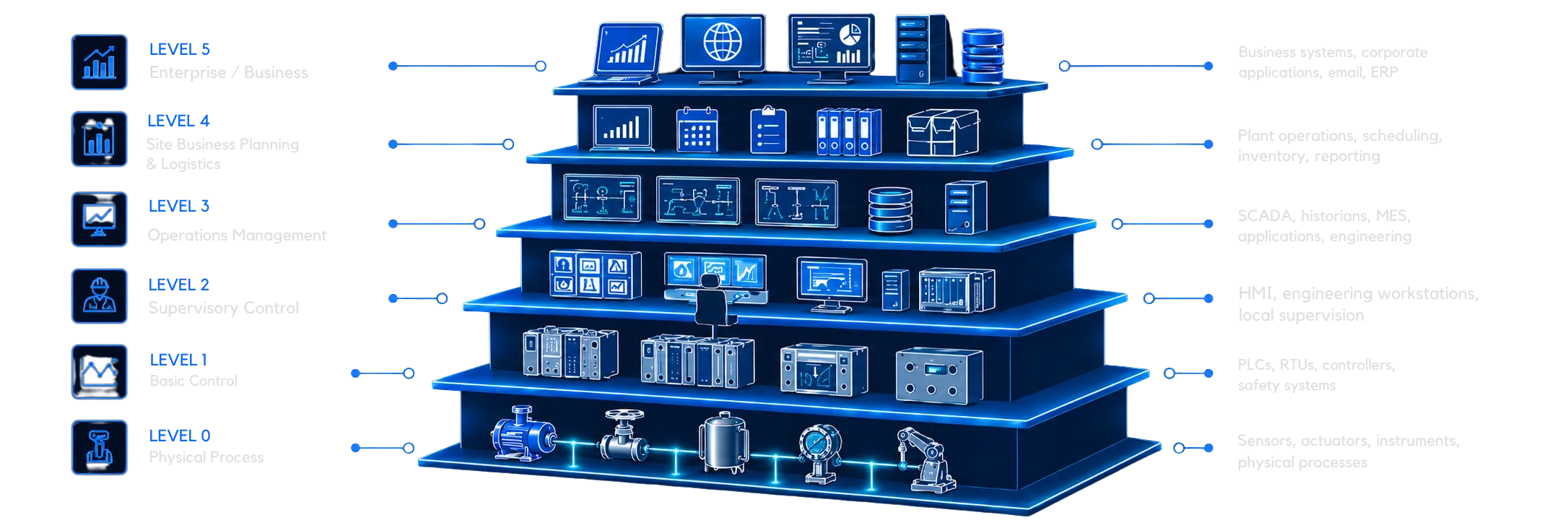
OT Secure Guard uses a practical zones-and-conduits mindset to reduce lateral movement, improve visibility, and protect operational continuity across enterprise, DMZ, OT, SCADA, controller, and physical process layers.
Operating Model
A Practical Blue-Team Model for OT Environments
The engagement is structured to move from visibility to control, monitoring, and response readiness without treating industrial systems like ordinary IT assets.
Discover
Map assets, communication paths, vendors, zones, and exposed services.
Assess
Review segmentation, remote access, vulnerabilities, and operational risk.
Harden
Apply practical controls that reduce risk without disrupting production.
Monitor
Create OT-specific detection use cases, alerting, and reporting visibility.
Respond
Prepare containment workflows, escalation paths, and recovery decisions.
Improve
Refine controls, documentation, monitoring, and resilience continuously.
Review Areas
Security Review Areas
OT Secure Guard reviews the areas that most directly influence industrial cyber resilience and production continuity.
Network Layer
- IT/OT segmentation
- Industrial DMZ
- Firewall rules
- VLANs and routing
- Remote access paths
Asset Layer
- PLCs and RTUs
- HMIs and SCADA servers
- Historians
- Engineering workstations
- Industrial IoT devices
Identity & Access
- Vendor accounts
- Privileged access
- Shared accounts
- MFA coverage
- Jump host governance
Monitoring & Detection
- SIEM visibility
- OT log sources
- Network traffic patterns
- Alert triage
- Anomaly monitoring
Resilience
- Backups
- Restore testing
- Manual fallback
- Incident response playbooks
- Business continuity alignment
Industries
Designed for Industrial and Critical Environments
Whether your OT environment is modern, legacy, hybrid, vendor-managed, or partially undocumented, OT Secure Guard helps create visibility and defensive control.
Framework Alignment
Aligned with Recognized OT Security Practices
OT Secure Guard is a practical security engagement that supports stronger alignment with recognized OT and cybersecurity practices. It is not positioned as a certification-issuing service.
 NIST SP 800-82
Guide to ICS Security
 IEC 62443
Industrial Automation Security
 CISA ICS Guidance
Industrial Control Systems Cybersecurity
 MITRE ATT&CK for ICS
Adversary Tactics for ICS
 NIST CSF
Cybersecurity Framework
 ISO 27001
Information Security Management
FAQ
Frequently Asked Questions
Clear answers for security leaders, plant managers, engineering teams, and compliance stakeholders evaluating OT Secure Guard.
What is OT Secure Guard?
OT Secure Guard is a defensive OT/ICS cybersecurity service designed to help industrial organizations improve visibility, segmentation, detection, risk prioritization, secure access, and incident readiness across operational technology environments.
Is OT security different from IT security?
Yes. OT security must account for production uptime, physical safety, legacy systems, specialized industrial protocols, vendor access, engineering workflows, and the consequences of disrupting operational processes.
Does OT Secure Guard include penetration testing?
OT Secure Guard is primarily a blue-team defensive service. Controlled exposure assessment, architecture review, configuration review, and safe validation can be included where appropriate, but intrusive testing must be carefully scoped for OT environments.
Can you secure legacy PLC and SCADA systems?
Yes. Many legacy PLC, HMI, SCADA, historian, and controller environments cannot be patched easily. OT Secure Guard focuses on compensating controls such as segmentation, access control, monitoring, vendor governance, and response readiness.
Can OT Secure Guard work with our existing SOC or SIEM?
Yes. The service can support OT detection engineering, SIEM integration planning, log source mapping, alert use-case development, reporting, and SOC workflow improvement.
Can this work with Power BI dashboards?
Yes. Executive posture, asset visibility, risk prioritization, and control readiness dashboards can be represented in Power BI-style reporting. Real-time packet-level monitoring or deep alert triage may require SIEM, network sensors, or a custom operational dashboard layer.
Do you provide IEC 62443 certification?
No. OT Secure Guard can help organizations align controls, review gaps, collect evidence, and improve readiness against IEC 62443 concepts, but it should not be presented as an accredited certification service.
Is active scanning safe in OT environments?
Active scanning can create risk in sensitive OT environments. OT Secure Guard should prioritize safe discovery, passive visibility where possible, careful change control, and approved testing windows for any active validation.
What assets are usually reviewed?
Common review targets include PLCs, RTUs, HMIs, SCADA servers, engineering workstations, historians, industrial switches, remote access systems, vendor access paths, and safety-related supporting infrastructure.
What does the OT Secure Guard Platform preview show?
The platform preview demonstrates how a client-facing dashboard could organize executive posture, asset visibility, risk prioritization, and control readiness views inside one unified reporting experience.
How does OT Secure Guard reduce production risk?
It reduces risk by identifying critical assets, mapping risky communication paths, improving segmentation, hardening remote access, prioritizing vulnerabilities, tuning detection, and preparing response workflows before disruption occurs.
Who should use this service?
OT Secure Guard is suitable for manufacturers, utilities, oil and gas operators, water facilities, logistics environments, smart buildings, pharmaceuticals, food production, and other organizations with industrial or critical operational systems.

Protect today. Prepare for tomorrow.
Ready To
Secure
What
Matters?
Talk to our experts and build a security program that protects your people, data, applications, AI systems, and future.