
RTCS WebFortress™
Secure Websites, Stores, and CMS Platforms Before Attackers Strike
WebFortress™ protects WordPress, WooCommerce, Shopify, Wix, PrestaShop, Joomla, Magento, OpenCart, custom websites, and e-commerce platforms with hardening, malware cleanup, checkout protection, vulnerability testing, continuous monitoring, and incident response support.
- Proactive website hardening
- Malware cleanup and recovery
- E-commerce checkout protection
- 24/7 monitoring support
Platforms We Protect
Website and e-commerce security for the platforms teams actually use.
 WP
WP Woo
Woo Shop
Shop PS
PS JML
JML MGT
MGT OC
OC Wix
WixWebsite Risk Reality
Why websites and online stores break down.
Most website breaches do not begin with advanced nation-state tactics. They begin with outdated plugins, weak admin access, exposed hosting, vulnerable checkout flows, unmonitored changes, and slow incident response.
Malware & Backdoors
Malicious code, web shells, backdoors, injected scripts, and unauthorized changes can damage trust and revenue.
Plugin & Theme Risk
Outdated or vulnerable plugins, themes, modules, and extensions often become the first attack path.
Checkout & Payment Exposure
Weak checkout controls, payment skimmers, insecure scripts, and misconfigured payment flows can put customers at risk.
Weak Access Controls
Default logins, shared accounts, weak passwords, missing MFA, and excessive privileges create takeover risk.
Hosting Misconfiguration
Open ports, weak file permissions, exposed backups, old PHP versions, and server errors expose your website.
Coverage Matrix
What RTCS WebFortress™ covers
WebFortress™ combines traditional website security, e-commerce protection, CMS hardening, checkout security, malware response, and ongoing defensive monitoring into one focused service.
Website Hardening
Secure configurations, headers, permissions, admin access, attack surfaces, and CMS security controls.
E-commerce Security
Checkout protection, payment-flow review, fraud-aware hardening, PCI-aware controls, and customer data protection.
Malware Cleanup
Deep scans, malware removal, backdoor investigation, integrity restoration, and post-cleanup hardening.
Vulnerability Assessment
Automated and manual testing to find real website, CMS, plugin, API, and configuration risks.
WAF & Bot Protection
Block exploit attempts, SQL injection, XSS, malicious traffic, brute force attempts, and abusive bots.
Patch & Plugin Review
Review core, plugin, theme, module, and extension risks and create a safer update strategy.
Secure Hosting & Cloud Review
Harden servers, storage, CDN, SSL/TLS, DNS, backups, and cloud infrastructure supporting the website.
Monitoring & Incident Support
Monitoring support, alerts, triage, rapid cleanup, response guidance, and recovery validation.
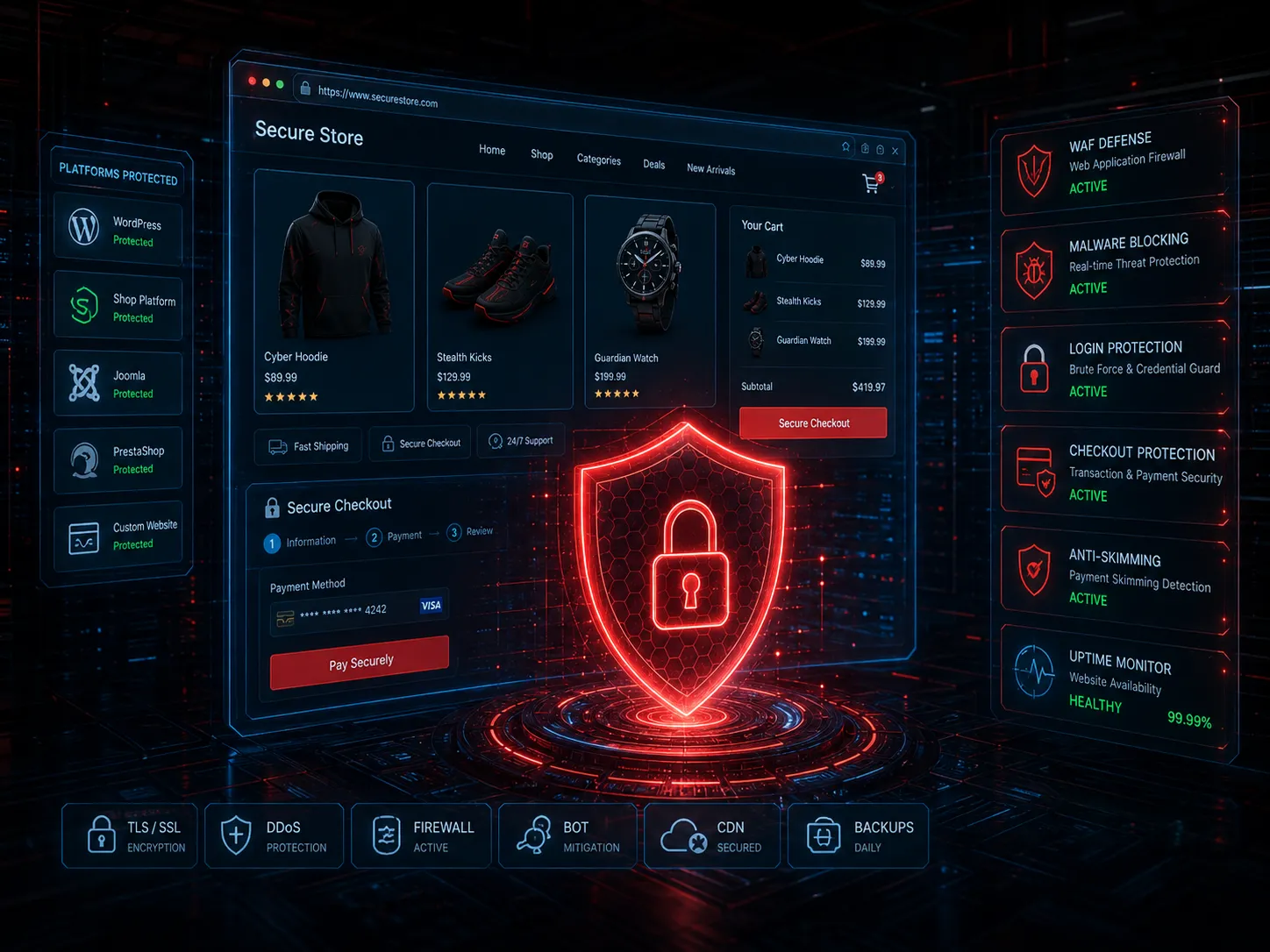
Storefront & Site Defense
Secure the customer journey from login to checkout.
E-commerce risk is not limited to uptime. A compromised checkout, payment skimmer, exposed admin account, malicious plugin, or weak hosting control can damage customer trust, revenue, and compliance posture.
- Login protection, MFA readiness, and brute-force resistance.
- Checkout protection, payment-flow review, and anti-skimming awareness.
- Malicious request blocking through WAF and bot-control layers.
- Uptime, performance, SSL/TLS, CDN, and customer trust checks.
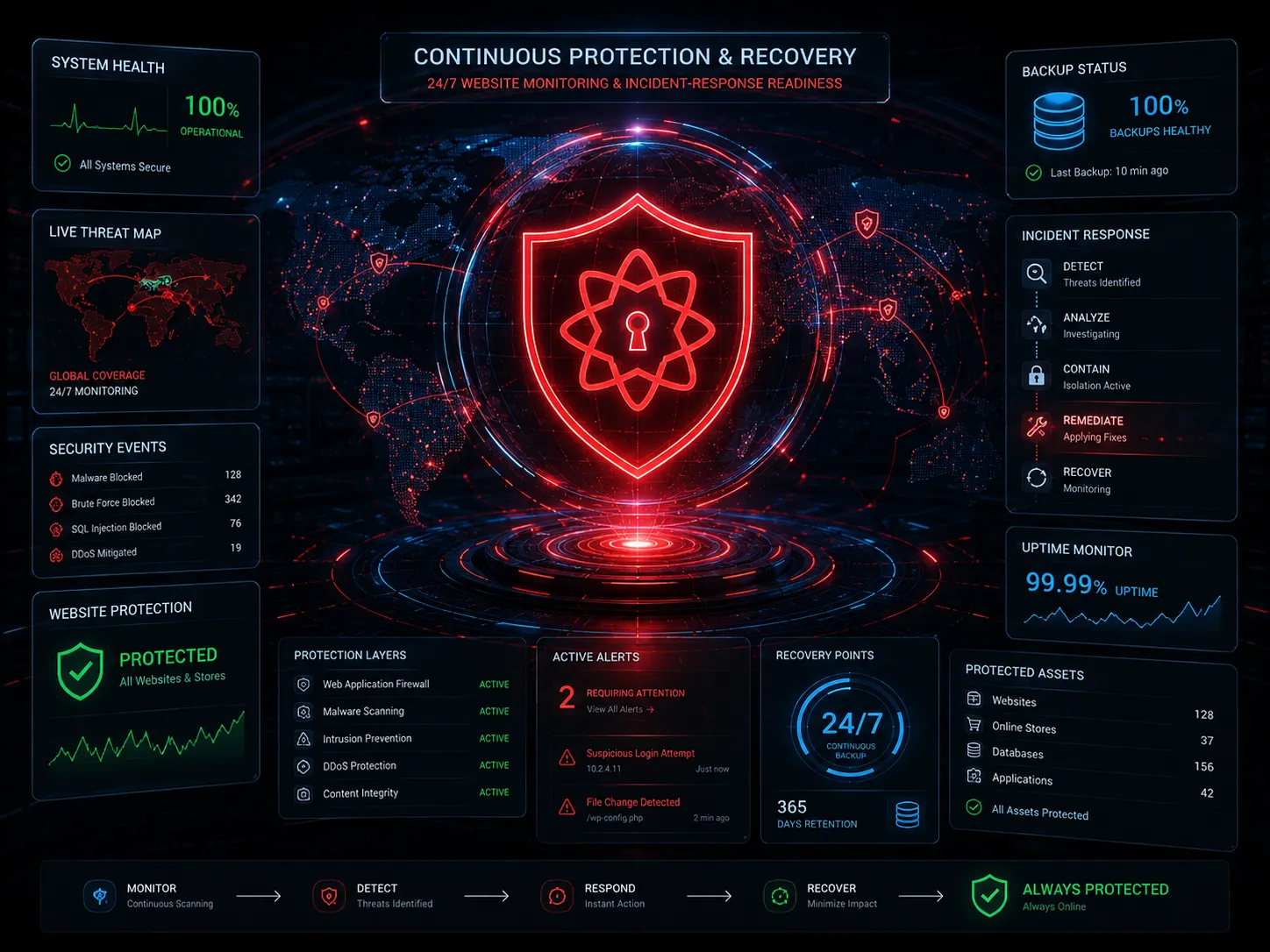
Continuous Protection & Recovery
Monitor, detect, respond, and recover before damage spreads.
WebFortress™ can support continuous website monitoring, uptime visibility, malware alerts, backup awareness, incident triage, cleanup coordination, and recovery validation for business-critical websites and online stores.
- Website monitoring and suspicious-change alerting.
- Backup awareness, restore validation, and recovery planning.
- Incident-response triage for hacked websites and infected stores.
- Ongoing hardening, threat intelligence, and remediation support.
Built on Global Standards
Aligned with the security practices buyers, auditors, and payment teams recognize.
 OWASP Top 10
Critical web risks
OWASP Top 10
Critical web risks OWASP ASVS
Verification standard
OWASP ASVS
Verification standard PCI DSS
Payment security
PCI DSS
Payment security GDPR
Data protection
GDPR
Data protection NIST CSF
Identify to recover
NIST CSF
Identify to recover CIS Controls
Security baselines
CIS Controls
Security baselines ISO 27001
Information security
ISO 27001
Information securityWebFortress™ Methodology
A practical path from exposed site to resilient web presence.
-
01
Discover
Map your website stack, CMS, plugins, extensions, hosting, DNS, checkout, and exposed assets.
-
02
Assess
Identify vulnerabilities, malware, misconfigurations, exposed services, and platform-specific weaknesses.
-
03
Harden
Secure configurations, access controls, headers, plugins, themes, hosting, and attack surfaces.
-
04
Protect
Deploy WAF, bot protection, monitoring, backup awareness, checkout controls, and defensive layers.
-
05
Monitor
Track uptime, suspicious changes, malware indicators, traffic anomalies, and website security events.
-
06
Recover
Support incident response, cleanup, containment, restoration, retesting, and post-incident improvements.
Who We Protect
Built for websites and stores where compromise creates business impact.
Website Security FAQ
WebFortress™ questions buyers ask.
Clear answers for business owners, CTOs, marketing teams, e-commerce managers, agencies, and compliance teams evaluating website security, CMS hardening, malware cleanup, and online store protection.
RTCS WebFortress™ is a website and e-commerce security service that helps protect WordPress, WooCommerce, Shopify, Wix, PrestaShop, Joomla, Magento, OpenCart, custom websites, and web applications through hardening, vulnerability assessment, malware cleanup, monitoring support, and incident response guidance.
Yes. E-commerce protection is now included inside WebFortress™ because online stores and websites share many of the same security concerns, including CMS risk, hosting exposure, checkout security, payment-flow protection, malware, monitoring, and recovery.
Yes. WebFortress™ can review WordPress core, plugins, themes, WooCommerce configuration, admin access, file permissions, hosting settings, malware indicators, WAF rules, backups, and checkout-related security concerns.
Yes. WebFortress™ can support Shopify store and Wix website security by reviewing app risk, staff permissions, checkout-related risk, theme integrity, DNS and domain security, third-party scripts, data exposure concerns, and operational security practices.
Yes. WebFortress™ is designed to support common CMS and e-commerce platforms including PrestaShop, Joomla, Magento, OpenCart, and custom sites where extensions, modules, server configuration, access controls, and outdated components can create risk.
Yes. RTCS can help investigate hacked websites, remove malware, identify backdoors, review suspicious files, restore integrity, harden the website after cleanup, and provide guidance to reduce reinfection risk.
Security changes should be scoped and tested carefully. WebFortress™ prioritizes practical controls, staged implementation, backup awareness, compatibility checks, and communication with website owners or developers to reduce disruption risk.
WebFortress™ can include website vulnerability assessment and security testing. Full penetration testing, API testing, application security testing, and business logic testing can be scoped separately where deeper validation is needed.
Yes. WebFortress™ includes e-commerce security support such as checkout review, payment-flow risk identification, anti-skimming awareness, customer-data protection checks, PCI-aware guidance, WAF recommendations, and third-party script review.
Yes. Depending on the engagement scope, RTCS can support monitoring, alerts, suspicious-change review, malware scan review, uptime visibility, backup awareness, incident triage, and recurring hardening improvements.
Response time depends on availability, scope, access, and severity. WebFortress™ is structured to support rapid triage, containment recommendations, malware cleanup planning, evidence review, restoration guidance, and post-incident hardening.
Yes. WebFortress™ is suitable for small business websites, startups, SaaS teams, online stores, agencies, healthcare websites, educational websites, and enterprise sites that need practical website security without unnecessary complexity.
Protect today. Prepare for tomorrow.
Ready To
Secure
What
Matters?
Talk to our experts and build a security program that protects your people, data, applications, AI systems, and future.